Frailty — the gradual loss of physical reserve that leaves older adults vulnerable to falls, illness, and loss of independence — is one of the most pressing challenges in aging medicine. At its core, frailty involves declining muscle mass and function, a condition closely linked to impaired energy production inside muscle cells. Researchers have increasingly focused on mitochondria, the cellular structures that generate energy, as a key driver of this decline.
Urolithin A is a compound produced when gut bacteria metabolize ellagitannins found in foods like pomegranates, walnuts, and certain berries. It has attracted scientific attention because it activates mitophagy — the cellular process by which damaged mitochondria are identified and recycled, allowing healthier ones to take their place. Several clinical trials have now tested whether supplementing with urolithin A can meaningfully support muscle health in aging adults, offering a potential nutritional approach to one dimension of frailty.
Key Takeaways
- Urolithin A activates mitophagy — the cellular recycling of damaged mitochondria — which declines with age and contributes to the muscle loss underlying frailty.
- A randomized clinical trial in older adults (65–90) found improvements in muscle endurance and mitochondrial gene expression markers after four months of urolithin A supplementation [1].
- Many older adults cannot efficiently produce urolithin A from food because their gut microbiome lacks the necessary bacteria, making supplemental forms relevant to research [2].
- No trial has yet measured urolithin A against clinical frailty endpoints like falls, hospitalizations, or formal frailty scores — the evidence base is mechanistic and performance-focused, not outcome-focused.
- Urolithin A appears safe in the doses studied, but it is a supplement, not a treatment, and should not replace medical management of sarcopenia or frailty.
Understanding Frailty and Its Cellular Roots
Frailty is not simply being ‘old and weak.’ Clinically, it describes a state of reduced physiological reserve in which even minor stressors — an infection, a missed meal, a fall — can trigger a cascade of serious consequences. Muscle loss is central to this picture. Sarcopenia, the age-related decline in skeletal muscle mass and strength, affects a substantial proportion of older adults and is a major contributor to frailty, disability, and loss of independence [3].
What drives sarcopenia at the cellular level? One well-studied factor is mitochondrial dysfunction. Aging muscle accumulates damaged, poorly functioning mitochondria that generate less energy and more oxidative stress. When the normal housekeeping process of mitophagy — the selective clearance of these dysfunctional mitochondria — slows down, muscle cells become progressively less efficient. Nutritional factors, including inadequate intake of compounds that support mitochondrial turnover, may accelerate this decline [4].
The gut microbiome also plays a role. The bacteria responsible for converting dietary ellagitannins into urolithin A are not evenly distributed across the population, and their abundance tends to decline with age. This means that older adults — the very group most likely to benefit from urolithin A — are often the least capable of producing meaningful amounts of it from food alone [2]. Changes in gut microbial ecology associated with aging have also been linked to sarcopenia through inflammatory and metabolic pathways [5].

How Urolithin A Activates Mitophagy
Mitophagy is a form of selective autophagy — the cellular ‘self-eating’ process by which damaged components are tagged, engulfed, and broken down for recycling. In healthy muscle, mitophagy continuously removes worn-out mitochondria, making room for new, functional ones. When this process is impaired, as commonly occurs with aging, dysfunctional mitochondria accumulate and muscle performance suffers.
Urolithin A was identified as a mitophagy activator through systematic screening of natural compounds. Unlike some interventions that broadly suppress autophagy or act through multiple simultaneous pathways, urolithin A appears to work specifically on the mitophagy axis, making it a relatively clean tool for studying this mechanism in humans. Early human clinical work confirmed that supplementation produces a detectable molecular signature of enhanced mitochondrial and cellular health in skeletal muscle, with a safety profile that was acceptable across multiple dose levels [6].
This mechanistic clarity is one reason urolithin A has been studied specifically in the context of aging and muscle health: restoring mitophagy to more youthful levels is a plausible, biologically grounded strategy for supporting the muscle quality that frailty erodes.
Clinical Evidence in Older Adults
The most directly relevant trial for frailty was a randomized clinical trial published in JAMA Network Open in 2022, enrolling older adults aged 65–90 who were not regularly exercising. Participants received either urolithin A supplementation or placebo for four months. Those in the urolithin A group showed significant improvements in muscle endurance — specifically in hand grip and the number of knee extension repetitions they could perform — compared to placebo. Skeletal muscle gene expression analyses suggested improvements in mitochondrial health markers [1].

A complementary trial published in Cell Reports Medicine the same year enrolled a middle-aged cohort and found that urolithin A supplementation over four months improved muscle strength, exercise performance, and several blood-based biomarkers associated with mitochondrial function compared to placebo [7]. While this cohort was younger than a typical frailty population, the mitochondrial biomarker improvements are mechanistically relevant to what occurs in aging muscle.
These findings are modest and specific — improvements in endurance and biomarkers, not reversal of frailty itself. Neither trial was designed to measure clinical frailty outcomes such as falls, hospitalizations, or functional independence, which would require much larger and longer studies.
Beyond Muscle: Joint and Broader Cellular Health
Frailty in older adults is rarely confined to muscle loss alone. Osteoarthritis, chronic pain, and reduced mobility compound the picture. A 2022 study in Aging Cell examined urolithin A in the context of osteoarthritis and reported that it reduced cartilage degeneration markers and alleviated pain in relevant models, with mitophagy activation proposed as the underlying mechanism [8]. While this is not a direct frailty trial, joint health and pain are significant contributors to the activity limitation that accelerates frailty progression.
More broadly, a systematic review of randomized controlled trials examining nutraceuticals and mitochondrial health in aging found that interventions targeting mitochondrial function showed mixed but occasionally positive effects on markers of cellular aging [9]. Urolithin A was among the compounds reviewed, reinforcing that its effects fit within a broader landscape of nutritional strategies targeting the biology of aging.

Individual Variability and the Gut Microbiome
A practical complication for using urolithin A from food sources is that the capacity to produce it varies widely between individuals, depending on gut microbiome composition. Studies have shown that the microbial metabolism of ellagitannins to produce urolithin A is not universal — a meaningful fraction of people lack the necessary gut bacteria to convert dietary precursors efficiently [2]. Age-related changes in gut microbial ecology, including reduced diversity and altered bacterial populations, may further impair this conversion in older adults [5].
This variability is part of the rationale for studying purified urolithin A supplements rather than food-based interventions: it removes the microbiome bottleneck and allows for more consistent dosing. Clinical trials to date have used standardized supplemental forms, so results from food-based approaches may differ substantially from person to person.
Where the Evidence Is Still Developing
Current trials, while promising in their mechanistic consistency, have notable limitations for frailty specifically. The largest trials have run for four months — long enough to detect biomarker and performance changes, but short relative to the timeline of frailty progression. None have used standard frailty assessment tools (such as Fried criteria or the Clinical Frailty Scale) as primary endpoints, and none have followed participants long enough to assess outcomes like falls or hospitalization.
Research in highly trained athletes suggests urolithin A may support mitochondrial biomarkers in that population as well [10], but translating findings from athletes to frail older adults requires caution — the biology of overtraining and aging muscle, while overlapping, are distinct. Autophagy-supporting compounds from other natural sources, such as those found in Castanea crenata flower extract, have shown muscle-protective effects in aging models [11], pointing to a broader class of mitophagy-activating interventions worth studying, though urolithin A remains the most clinically tested in humans.
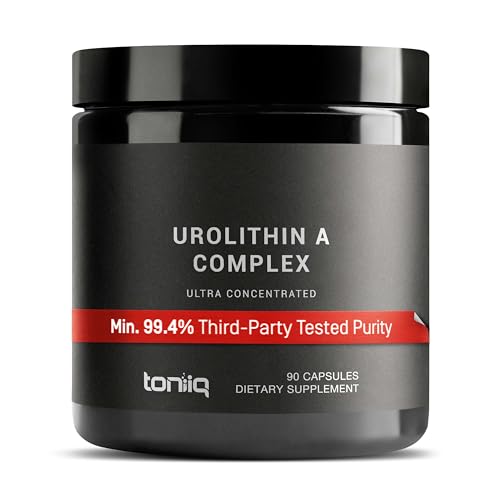
🛒 Where to Buy Urolithin A

- Timeline Mitopure SoftgelsClinically studied
softgels, 500 mg/day — The clinically studied form (Amazentis); used in the human trials. - Pure Encapsulations Renual
caplique capsules, 250 mg Mitopure Urolithin A/serving (with resveratrol + CoQ10) — established clinical-supplement brand, third-party tested. - ProHealth Longevity Urolithin A
capsules, 500 mg — Longevity-focused brand, often higher dose. - Double Wood Urolithin A
capsules, 250-500 mg — Budget-friendly, widely available, COA on request.
As an Amazon Associate we earn from qualifying purchases. Prices and availability vary; verify dose and third-party testing before buying.
A Note on the Evidence
The clinical evidence for urolithin A and muscle health is promising but early — trials to date have been small, short, and have not measured clinical frailty outcomes such as falls or loss of independence. Urolithin A is a dietary supplement, not a treatment for frailty or sarcopenia, and should not replace medical care, exercise, or adequate protein intake. Older adults with chronic illnesses, kidney disease, or who take multiple medications should consult a physician before adding any new supplement.
Frequently Asked Questions
What is urolithin A and where does it come from?
Urolithin A is a compound produced by gut bacteria when they metabolize ellagitannins — polyphenols found in pomegranates, walnuts, and certain berries. Because production depends on specific gut microbes, many people cannot generate meaningful amounts from food alone [2]. Supplemental forms bypass this variability.
How does urolithin A relate to muscle aging and frailty?
Age-related muscle loss (sarcopenia) involves accumulation of dysfunctional mitochondria in muscle cells. Urolithin A activates mitophagy — the process that clears these damaged mitochondria — which tends to slow down with aging. By restoring mitophagy, urolithin A may support muscle quality at the cellular level [6]. Sarcopenia is a central contributor to frailty in older adults [3].
Has urolithin A been tested specifically in older adults?
Yes. A randomized trial in adults aged 65–90 found that four months of urolithin A supplementation improved muscle endurance (grip strength and knee extension repetitions) and showed changes in mitochondrial health gene expression in skeletal muscle, compared to placebo [1]. This is the most directly relevant trial for a frailty-adjacent population.
Does urolithin A reduce frailty itself?
Not as directly measured. No published trial has used formal frailty assessment tools as primary endpoints or tracked frailty-related outcomes like falls or functional decline over time. The existing evidence covers muscle endurance, exercise performance, and mitochondrial biomarkers — meaningful signals, but not the same as demonstrated reductions in clinical frailty.
Is urolithin A safe for older adults to take?
Early safety data from dose-escalation studies found urolithin A was well tolerated across multiple dose levels in adults, with no serious adverse events attributed to the supplement [6]. However, as with any supplement, older adults — especially those with chronic conditions or taking multiple medications — should discuss it with their doctor before starting.
Can diet alone provide enough urolithin A to support muscle health?
Probably not for most older adults. The gut bacteria needed to convert ellagitannins to urolithin A are not universally present, and their abundance may decline with age-related changes in gut microbial ecology [5]. Clinical trials showing muscle benefits used standardized supplement forms, not dietary interventions, so food-based strategies cannot be assumed to produce equivalent results.
References
- Liu S et al. Effect of Urolithin A Supplementation on Muscle Endurance and Mitochondrial Health in Older Adults: A Randomized Clinical Trial. JAMA network open (2022). PMID 35050355
- Selma MV et al. The human gut microbial ecology associated with overweight and obesity determines ellagic acid metabolism. Food & function (2016). PMID 26597167
- Dao T et al. Sarcopenia and Muscle Aging: A Brief Overview. Endocrinology and metabolism (Seoul, Korea) (2020). PMID 33397034
- Guralnik JM et al. Nutritional Mediators of Cellular Decline and Mitochondrial Dysfunction in Older Adults. Geriatrics (Basel, Switzerland) (2021). PMID 33917371
- Wang M et al. Age-related sarcopenia and altered gut microbiota: A systematic review. Microbial pathogenesis (2024). PMID 39142365
- Andreux PA et al. The mitophagy activator urolithin A is safe and induces a molecular signature of improved mitochondrial and cellular health in humans. Nature metabolism (2019). PMID 32694802
- Singh A et al. Urolithin A improves muscle strength, exercise performance, and biomarkers of mitochondrial health in a randomized trial in middle-aged adults. Cell reports. Medicine (2022). PMID 35584623
- D'Amico D et al. Urolithin A improves mitochondrial health, reduces cartilage degeneration, and alleviates pain in osteoarthritis. Aging cell (2022). PMID 35778837
- Lippi L et al. Impact of nutraceuticals and dietary supplements on mitochondria modifications in healthy aging: a systematic review of randomized controlled trials. Aging clinical and experimental research (2022). PMID 35920994
- Whitfield J et al. Evaluating the Impact of Urolithin A Supplementation on Running Performance, Recovery, and Mitochondrial Biomarkers in Highly Trained Male Distance Runners. Sports medicine (Auckland, N.Z.) (2025). PMID 40839339
- Park SH et al. A Natural Autophagy Activator Castanea crenata Flower Alleviates Skeletal Muscle Ageing. Journal of cachexia, sarcopenia and muscle (2025). PMID 39873130
These statements have not been evaluated by the Food and Drug Administration. This information is not intended to diagnose, treat, cure, or prevent any disease. Content is for informational purposes only and is not medical advice; consult a qualified healthcare provider before starting any supplement. As an Amazon Associate we earn from qualifying purchases.