Sarcopenia—the progressive loss of skeletal muscle mass and strength that accompanies aging—is one of the most consequential, yet underappreciated, health challenges of later life. It contributes to falls, frailty, loss of independence, and increased mortality risk [1]. Despite its prevalence, effective pharmacological treatments remain limited, which has prompted researchers to examine whether certain naturally derived compounds might support muscle health through cellular mechanisms.
Urolithin A is one such compound. Produced in the gut from polyphenols found in foods like pomegranates, walnuts, and some berries, it has attracted scientific attention primarily because of its ability to activate mitophagy—the cellular process by which damaged mitochondria are cleared and recycled. Since mitochondrial dysfunction plays a central role in age-related muscle decline, this mechanism makes urolithin A a plausible research target. This article reviews what the current evidence shows, and where important gaps remain.
Key Takeaways
- Sarcopenia is a clinically significant age-related condition driven in part by declining mitochondrial health in skeletal muscle [1].
- Urolithin A activates mitophagy—cellular removal of damaged mitochondria—which is a mechanistically plausible approach to slowing muscle aging [2].
- Animal studies showed improved muscle function with urolithin A supplementation; the first human trials confirmed safety and mitochondrial molecular changes [3][4].
- A randomised controlled trial in middle-aged adults found improvements in muscle strength, exercise performance, and mitochondrial biomarkers [5].
- The evidence base is promising but still early: larger and longer trials in older, sarcopenic populations are needed before firm conclusions can be drawn [6].
What Sarcopenia Is and Why It Happens
Sarcopenia is broadly defined as age-related loss of skeletal muscle mass combined with reduced muscle strength or physical performance. It is not simply a cosmetic concern: the condition is associated with increased fall risk, reduced metabolic health, and higher rates of hospitalisation and mortality in older adults [1]. Muscle tissue is metabolically active, and its decline has knock-on effects throughout the body.
The causes of sarcopenia are multifactorial. Declining anabolic hormone levels, chronic low-grade inflammation, inadequate physical activity, poor nutrition, and changes in motor neurone function all play a role. Emerging research also points to the gut microbiome: a 2024 systematic review found that age-related shifts in gut microbial composition are associated with sarcopenic outcomes, potentially through effects on nutrient absorption, inflammation, and the production of bioactive metabolites—including urolithin A itself [7]. This gut-muscle axis is an active area of investigation.

Mitochondria and the Aging Muscle
Skeletal muscle is one of the most mitochondria-dense tissues in the body, and the health of those mitochondria is tightly linked to muscle function. With age, mitochondria accumulate damage—defective proteins, oxidised lipids, mutations in mitochondrial DNA—and their ability to produce energy efficiently deteriorates. This decline in mitochondrial quality and quantity is considered a key driver of the muscle weakness and fatigue characteristic of sarcopenia [8].
A 2024 review in Sports Medicine concluded that mitochondria represent meaningful nutritional targets for preserving muscle health and physical function during ageing, and that interventions capable of improving mitochondrial turnover may have practical relevance for sarcopenia prevention [8]. The challenge is identifying compounds that actually move the needle in a meaningful and safe way in humans.
Mitophagy: The Cellular Recycling Process Urolithin A Activates
Mitophagy is a selective form of autophagy—the broader cellular self-cleaning process—in which damaged or dysfunctional mitochondria are tagged, engulfed, and broken down so their components can be reused. Think of it as the cell’s quality-control mechanism for its energy-producing organelles. When mitophagy works well, the cell’s mitochondrial population stays relatively healthy. When it slows down, damaged mitochondria accumulate and cellular function degrades.
Urolithin A is notable because it appears to be one of relatively few naturally occurring compounds capable of directly stimulating mitophagy. A 2024 review focused specifically on this mechanism in the context of muscle ageing concluded that urolithin A’s mitophagy-activating properties position it as a candidate compound for addressing age-related skeletal muscle decline [2]. Importantly, this is a mechanism-based rationale, not simply an observation that the compound is ‘natural’ or ‘anti-inflammatory.’

What Preclinical Studies Found
The most widely cited early study on urolithin A and muscle function was published in Nature Medicine in 2016. The researchers found that urolithin A induced mitophagy in the roundworm C. elegans, extending lifespan, and that supplementation increased muscle function in both young and aged rodent models. Specifically, older rats receiving urolithin A showed improved running capacity and grip strength compared to controls [3]. While animal data does not automatically translate to humans, this study established a mechanistic and functional proof of concept that shaped subsequent research.
More recent preclinical work has extended these findings into adjacent contexts. A 2025 study in the Journal of Cachexia, Sarcopenia and Muscle examined sepsis-induced muscle loss—a condition involving severe mitochondrial and autophagy disruption—and found that urolithin A was able to partially restore mitochondrial function and attenuate muscle degradation in the animal model [9]. While sepsis-related muscle loss is distinct from normal sarcopenia, the finding reinforces urolithin A’s relevance to mitophagy-driven muscle pathology.
Human Evidence: Safety and Molecular Signatures
Translating preclinical findings into humans requires careful, controlled trials. A 2019 study published in Nature Metabolism was the first to test oral urolithin A supplementation in humans. The researchers conducted a first-in-human trial involving elderly individuals and found that urolithin A was well tolerated at all tested doses and produced measurable changes in gene expression in skeletal muscle consistent with improved mitochondrial and cellular health. The authors described the compound as safe and noted it induced a molecular signature of mitochondrial renewal [4]. This study did not measure strength or physical performance as primary endpoints.
A subsequent randomised controlled trial published in Cell Reports Medicine in 2022 took the next step by measuring functional outcomes. In middle-aged adults, supplementation with urolithin A for four months led to improvements in muscle strength, aerobic endurance, and biomarkers associated with mitochondrial health compared to placebo [5]. This is considered meaningful because it moves beyond molecular signals to outcomes people actually care about. That said, this was a single trial in a relatively healthy, middle-aged population—it does not yet establish urolithin A as a treatment for clinical sarcopenia in elderly individuals.
Where the Evidence Stands: Promising but Preliminary
A 2023 scoping review examined the broader evidence base for urolithin A across age-related diseases and concluded that while the compound shows promise across several domains—including muscle health, neurological function, and metabolic parameters—the clinical evidence remains early-stage and larger trials are needed [6]. A scoping review maps available evidence rather than synthesising it for effectiveness conclusions, which is an honest reflection of where the field is.
A 2021 review in Trends in Molecular Medicine similarly characterised urolithin A as a compelling research compound whose effects on health, disease, and ageing are supported by a growing but still developing evidence base [10]. The mechanistic rationale is coherent—mitophagy matters, urolithin A activates it, mitochondrial health affects muscle—but the clinical trials needed to establish dosing, efficacy in sarcopenic populations specifically, and long-term safety are still underway or unpublished.
One factor that complicates the picture is individual variation in urolithin A production. Not everyone’s gut microbiome converts dietary polyphenols into urolithin A efficiently. This means that food-based approaches may have unpredictable effects, which is partly why clinical research has focused on direct supplementation rather than dietary modification [7].
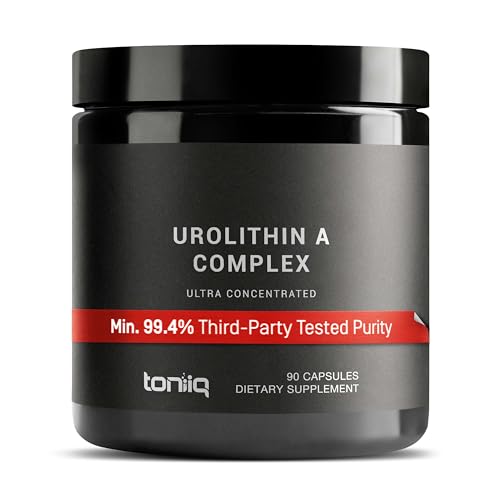
🛒 Where to Buy Urolithin A
- Timeline Mitopure SoftgelsClinically studied
softgels, 500 mg/day — The clinically studied form (Amazentis); used in the human trials. - Pure Encapsulations Renual
caplique capsules, 250 mg Mitopure Urolithin A/serving (with resveratrol + CoQ10) — established clinical-supplement brand, third-party tested. - ProHealth Longevity Urolithin A
capsules, 500 mg — Longevity-focused brand, often higher dose. - Double Wood Urolithin A
capsules, 250-500 mg — Budget-friendly, widely available, COA on request.
As an Amazon Associate we earn from qualifying purchases. Prices and availability vary; verify dose and third-party testing before buying.

A Note on the Evidence
The clinical evidence for urolithin A and muscle health is promising but still early-stage; most trials have been short-term and conducted in healthy middle-aged adults, not in people with diagnosed sarcopenia. Urolithin A supplements are not a substitute for medical evaluation or treatment, and anyone experiencing significant muscle weakness, unexplained fatigue, or mobility changes should consult a qualified healthcare professional.
Frequently Asked Questions
What is urolithin A and where does it come from?
Urolithin A is a compound produced by gut bacteria when they metabolise ellagitannins—polyphenols found in pomegranates, walnuts, and certain berries. It is not present in food directly; your microbiome makes it. Not everyone produces it in meaningful quantities, which depends on individual gut microbiota composition [7].
How does urolithin A potentially help with muscle aging?
The primary proposed mechanism is mitophagy activation—urolithin A stimulates the cellular process that identifies and removes dysfunctional mitochondria. Because mitochondrial decline is a key driver of age-related muscle deterioration, compounds that restore mitochondrial turnover may help preserve muscle health over time [2][8].
Has urolithin A been tested in humans for muscle health?
Yes. A first-in-human study published in 2019 found urolithin A was safe and produced gene expression changes in muscle consistent with improved mitochondrial health [4]. A subsequent 2022 randomised controlled trial in middle-aged adults found improvements in muscle strength, aerobic endurance, and mitochondrial biomarkers compared to placebo [5].
Does urolithin A treat or cure sarcopenia?
No clinical evidence to date supports calling urolithin A a treatment or cure for sarcopenia. Existing trials have primarily involved healthy or middle-aged adults, not individuals diagnosed with sarcopenia. A 2023 scoping review concluded the compound shows promise but that larger clinical trials are still needed [6].
Is urolithin A safe to take?
The available human data suggest it is well tolerated. A 2019 first-in-human clinical trial tested multiple doses in elderly subjects and reported no serious adverse events, concluding the compound has an acceptable safety profile [4]. However, long-term safety data in large populations is not yet available, and this should be weighed accordingly.
Can I get enough urolithin A from food alone?
This depends heavily on your individual gut microbiome. Because urolithin A is produced by specific gut bacteria from dietary polyphenols, people who lack those bacteria will produce little or none regardless of diet. This variability is part of why researchers have focused on direct supplementation in clinical trials rather than dietary modification [7].
References
- Dao T et al. Sarcopenia and Muscle Aging: A Brief Overview. Endocrinology and metabolism (Seoul, Korea) (2020). PMID 33397034
- Faitg J et al. Mitophagy Activation by Urolithin A to Target Muscle Aging. Calcified tissue international (2024). PMID 37925671
- Ryu D et al. Urolithin A induces mitophagy and prolongs lifespan in C. elegans and increases muscle function in rodents. Nature medicine (2016). PMID 27400265
- Andreux PA et al. The mitophagy activator urolithin A is safe and induces a molecular signature of improved mitochondrial and cellular health in humans. Nature metabolism (2019). PMID 32694802
- Singh A et al. Urolithin A improves muscle strength, exercise performance, and biomarkers of mitochondrial health in a randomized trial in middle-aged adults. Cell reports. Medicine (2022). PMID 35584623
- Kothe B et al. Urolithin A as a Potential Agent for Prevention of Age-Related Disease: A Scoping Review. Cureus (2023). PMID 37637627
- Wang M et al. Age-related sarcopenia and altered gut microbiota: A systematic review. Microbial pathogenesis (2024). PMID 39142365
- Broome SC et al. Mitochondria as Nutritional Targets to Maintain Muscle Health and Physical Function During Ageing. Sports medicine (Auckland, N.Z.) (2024). PMID 39060742
- Pierre A et al. Sepsis Induces Long-Term Muscle and Mitochondrial Dysfunction due to Autophagy Disruption Amenable by Urolithin A. Journal of cachexia, sarcopenia and muscle (2025). PMID 40817441
- D'Amico D et al. Impact of the Natural Compound Urolithin A on Health, Disease, and Aging. Trends in molecular medicine (2021). PMID 34030963
These statements have not been evaluated by the Food and Drug Administration. This information is not intended to diagnose, treat, cure, or prevent any disease. Content is for informational purposes only and is not medical advice; consult a qualified healthcare provider before starting any supplement. As an Amazon Associate we earn from qualifying purchases.