Urolithin A (branded as Mitopure) has one of the cleaner safety records of any longevity supplement on the market, which makes its negative reviews unusually consistent: almost nobody complains it hurt them, but plenty of people complain it wasn’t worth what they paid. The second large group, easy to miss if you only read the safety literature, is people for whom it simply did nothing.
This page collects what those complaints actually say, what the clinical data does and does not support, and where the two groups are talking past each other.
Key Takeaways
- Clinical reviews report no serious adverse events across the trials examined[1]
- The most common negative theme is price versus perceived benefit, not safety[2]
- A large “non-responder” group reports no felt change at all, which is the complaint the safety data cannot address[2]
- Both pivotal trials missed their own pre-specified primary endpoint, while secondary measures improved[3][4]
- A one-time month of Mitopure is $125, roughly $4.17 per serving, which is the number most negative reviews are reacting to[5]
- Independent testing of urolithin A supplements found label deviations from +28.6% to -100%, so “cheaper” carries its own risk[6]
- A minority report mild, temporary headaches, increased mucus, or an early-evening energy crash[2]
The Real Complaint: Price, Not Safety
Across forums and review sites, the most consistent negative sentiment isn’t about side effects, it’s about value. One Reddit user summarized the prevailing skepticism bluntly: “Given how expensive Mitopure is, I’d say most people should skip it.”[2] Another described trying it once and moving on: “Worth trying once, but for the price I probably won’t buy it again.”[2] Some users actively look for cheaper substitutes, with one claiming a different, less expensive compound “gives me anti-fatigue benefits similar to Urolithin A at a lower cost.”[2] This pattern, trying it, not seeing an obvious enough benefit to justify the price, then switching or stopping, is the single most common story in the negative reviews.
Those reviews are reacting to a specific number. A one-time purchase of Mitopure is $125 for a 30-day supply, which works out to about $4.17 per serving[5]. Subscribing lowers the per-serving cost, but only by committing up front: $112.50 for a single month, $200 for two months, $380 for four months, or $1,020 for twelve, which brings it down to roughly $2.83 per serving at the largest tier[5]. Even outside the Mitopure brand, high-quality urolithin A tends to start around $60 per bottle[5]. For a supplement whose benefits are real but subtle, that is the entire argument happening in the negative reviews.
“It Did Nothing For Me”: The Complaint Safety Data Cannot Answer
Price is the loudest theme, but it is not the only one, and the second is easy to overlook. Compilations of Reddit discussion describe a substantial group of users who experience no measurable change at all[2]. Two representative accounts: “No effect on me at all. I suspect it’s not going to work,” and “I haven’t seen any change in strength, stamina, or daily energy.”[2]
This non-responder group appears to be large, and the explanations usually offered are differences in gut bacteria, baseline health, and lifestyle[2]. There is a mechanistic reason to expect exactly this. Urolithin A is not a compound you eat directly. It is produced by gut bacteria from ellagitannins in foods like pomegranate and walnuts, and only around a third of people produce it naturally in meaningful amounts[2]. That fact is the entire premise for supplementing it. It also means the buying population is genuinely heterogeneous, and a product that reliably raises a blood metabolite will not reliably produce a sensation.
One distinction is worth holding onto here: no felt effect is not the same as no effect. What the trials measured is the subject of the next section, and it is not the thing most buyers are checking for.
What the Trials Actually Measured, and Why That Produces Disappointed Reviews
Much of the gap between the clinical literature and the review sections is a gap in endpoints. A 2022 randomized, placebo-controlled trial in middle-aged adults found that urolithin A improved leg muscle strength, maximum torque during knee flexion, average peak torque in the quadriceps, and average peak torque in the hamstring[3][5]. It also found no body composition changes in either group, and only the 1,000 mg dose showed what was described as clinically meaningful improvement in aerobic endurance[5].
What that trial did not find is the one outcome it had named in advance. Its authors report that they did not notice a significant improvement on peak power output, and peak power output was the study’s primary endpoint[3]. Every measure in the list above is a secondary one. The trial was also sponsored by Amazentis SA, the company that sells Mitopure, and its authors are employees, board members, or scientific advisory board members of that company[3]. That does not make the findings wrong, but it is the kind of thing a reader weighing $125 a month is entitled to know.
Read that list of outcomes from a buyer’s point of view. Average peak hamstring torque is not something anyone notices on a Tuesday. An earlier 2019 trial in healthy, sedentary older adults similarly reported bioavailability and improved mitochondrial and cellular biomarkers at both 500 mg and 1,000 mg over four weeks[5], which is again a laboratory result rather than a felt one.
The trial most relevant to the “it did nothing for me” reviews is one this page has not mentioned yet, and the reason it gets quoted less is that its headline result was negative. A 2022 randomized, placebo-controlled trial published in JAMA Network Open gave 1,000 mg of urolithin A or placebo to 66 adults aged 65 to 90 for four months[4]. Its two primary endpoints were the change in 6-minute walk distance and the change in maximal ATP production in hand muscle. On both, the authors state the results showed no significant improvement with urolithin A compared with placebo[4]. What did improve was a secondary endpoint, muscle endurance measured as the number of muscle contractions before fatigue, along with plasma markers including C-reactive protein[4]. That trial was run at the University of Washington and VA Puget Sound, with co-authors from Amazentis[4].
Across the two most-cited human trials, then, the pattern is the same one the negative reviews describe from the other side: the pre-registered headline measure did not move, and what moved was secondary. That is not the same as the supplement doing nothing, and both trials did find real changes. It does mean the reviewer who says “I felt nothing” is standing closer to the trial data than the marketing is.
So the honest summary is that the evidence supports measurable changes in muscle performance and mitochondrial biomarkers, not a noticeable lift in day-to-day energy. People who buy it expecting the second and receive the first write negative reviews, and they are not being unreasonable. They were sold on a feeling the trials never measured.
Mild Side Effects: Real But Uncommon
A 2024 systematic review of urolithin A studies in humans found no serious adverse reactions reported in any of the studies examined[1]. The mild effects that do show up are specific: myalgia (muscle aches), occasional headaches, and digestive discomfort, all classified as minor[1]. On forums, individual accounts echo this: one user reported “it increased mucus production in my gut and even my sinuses,” while another described “a low-grade headache for several days when starting.”[2] A third described a timing effect rather than a symptom: “I crash extremely hard about four hours before my usual bedtime.”[2] These are real reports worth knowing about, but they’re notably absent from any serious-harm category.
Complaints About the Product, Not the Compound
A separate cluster of negative reviews has nothing to do with urolithin A itself.
Reviewers who tested Mitopure hands-on reported that some capsules leaked oil inside the bottle, coating the other capsules, which raises a fair question about whether those capsules still delivered a full 500 mg dose[5]. That is a packaging complaint, but it lands as a potency complaint.
Buying through Amazon introduces its own category. The only official seller is “Timeline Mitopure,” and third-party resellers may list items stored in improper conditions or that are not genuine, with some Amazon reviews specifically describing melted pills[5]. If you are buying the branded product, checking the seller name matters as much as checking the price.
The subscription generates complaints too. Pausing or cancelling requires contacting customer service rather than doing it from an account settings page[5]. That is a familiar friction pattern, and it shows up in reviews written by people who otherwise liked the product.
If You Switch to a Cheaper Urolithin A, Here Is the Actual Risk
The most common piece of advice inside the negative reviews is to buy something cheaper. Reddit threads point to pomegranate extract, to Robuvit, and to the argument that it may be cheaper to support Akkermansia and eat ellagitannin-rich foods than to buy the finished metabolite[2]. Those are reasonable instincts, though only the last addresses the same pathway, and none of them have been studied the way Mitopure has.
If you do go generic, the risk is not mainly that it will be weaker. It is that you may not be buying what the label says. A 2024 analysis published in GeroScience tested commercially available nicotinamide mononucleotide and urolithin A supplements against their label claims and found deviations ranging from +28.6% to -100%[6]. A deviation of -100% means the product contained none of the labeled active ingredient. The authors point out that safety regulators verify the absence of prohibited compounds, not the accuracy of what is printed on the label[6].
That is the real trade being made. The branded product’s answer to this problem is third-party certification: Mitopure is NSF Certified for Sport, which verifies that contents match the label[5]. A generic that is meaningfully cheaper is only a better deal if it can answer the same question. When comparing lower-cost urolithin A products, the things worth checking are whether the dose per serving is stated plainly, whether the product is third-party tested, and whether the listing is sold by the actual brand rather than an unidentified reseller.
Three widely available options show what that checklist looks like in practice. None of them carries the NSF Certified for Sport mark that Mitopure does, and the details below are the manufacturers’ own label claims rather than independent verification, which is exactly the gap the GeroScience testing exposed[6]. They are worth looking at because each answers at least one of the questions above in writing, which is more than the cheapest listings do.
ProHealth Full Spectrum Urolithin A
A 60-count full-spectrum formula that pairs urolithin A with pomegranate and red grape extracts, and the only one of these three whose listing makes an explicit testing claim, describing itself as triple lab-tested and manufactured in the USA. If your main worry after reading the label-accuracy data is whether anyone checked the contents, that is at least the right category of answer.

Double Wood Urolithin A 500mg, 60 Capsules
The plainest version of the product: 500 mg per serving, a stated 30-day supply, and nothing else in the bottle. It answers the “is the dose per serving stated clearly” question directly, and with a single-ingredient format there is only one number on the label that has to be right.


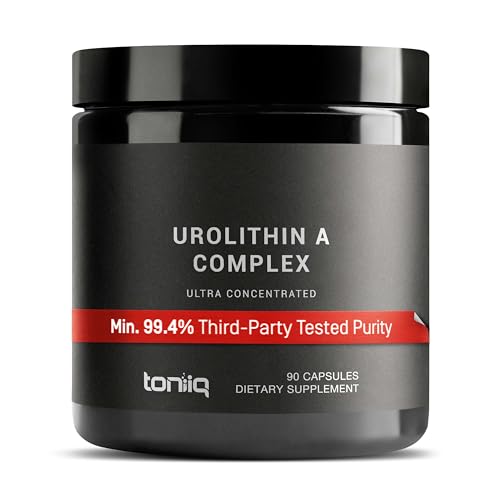
Toniiq 4-in-1 Urolithin A Complex
A 1,500 mg four-ingredient complex built around 500 mg of urolithin A. That distinction is worth understanding before buying, because the headline number and the urolithin A number are not the same, which is the most common source of confusion in combination formulas. If you want to compare against the 500 mg and 1,000 mg doses used in the trials[5][3], the figure to compare is the 500 mg, not the 1,500 mg.
Does It Actually Work? Reviewers Split Three Ways, Not Two
Taken together, the reviews sort into three groups.
Some users report clear benefit. Compiled accounts include “My energy levels went up, my HRV has bounced back and I’m working out every morning now,” and, from someone tracking post-exertional malaise, “In the past month my PEM days have shortened, I’m having more good days than usual.”[2]
Some report nothing at all, as covered above[2].
And a third group only noticed while stopping. One reviewer described increased muscle fatigue after discontinuing, with exercise tolerance and mental alertness returning within about a week of resuming[1]. That pattern, an effect easier to detect on withdrawal than on onset, is consistent with trial endpoints that are measurable but not dramatic, and it is the strongest argument against treating “I felt nothing in week two” as a final verdict.
Who Should Probably Skip It
Based on what the complaints actually say rather than on what the marketing says:
- If $125 a month is a stretch, skip it. The most common regret in the negative reviews is financial, not medical[2][5].
- If you want a noticeable energy lift, the trial endpoints do not support that expectation[5][3].
- If you are unwilling to give it more than a couple of weeks, note that the trials ran four weeks or longer, and the clearest user accounts describe subtle effects noticed over months[1][5].
- If your plan is to buy the cheapest listing you can find, the label-accuracy data argues against it[6]. Paying less for a product that may contain none of the active ingredient is worse value than not buying at all.
One frequently repeated piece of Reddit advice is worth quoting for its bluntness: “If you can’t afford it, do zone 2 cardio instead.”[2]
Frequently Asked Questions
Is Mitopure/Urolithin A safe?
Clinical trial data reviewed to date shows no serious adverse events, with only mild, occasional side effects like headache or muscle soreness reported[1].
Do the negative reviews say it doesn’t work at all?
A substantial group does report no measurable change, and the usual explanations are differences in gut bacteria, baseline health, and lifestyle[2]. That group coexists with users reporting clear benefit and with users who only noticed a difference after stopping[1][2].
Did the urolithin A trials meet their primary endpoints?
No. The 2022 trial in middle-aged adults reports that it did not notice a significant improvement on peak power output, which was its primary endpoint[3]. The 2022 trial in adults aged 65 to 90 found no significant improvement on either of its two primary endpoints, 6-minute walk distance and maximal ATP production[4]. In both trials, secondary measures did improve, including muscle strength, muscle endurance and mitochondrial biomarkers[3][4].
Why do so many negative reviews focus on price?
Price is the most common single theme, but the two big complaints reinforce each other: a benefit subtle enough that many people don’t feel it is easy to judge as not worth roughly $4.17 a serving[2][5].
Why does it seem to work for some people and not others?
Urolithin A is produced by gut bacteria from ellagitannins, and only about a third of people produce it naturally in meaningful amounts, which is the reason the supplement exists[2]. Differences in gut bacteria, overall health, and lifestyle are the leading explanations offered for non-response[2].
Are there cheaper alternatives people switch to?
Some users mention trying other compounds marketed for similar energy and fatigue support at a lower price point, though these aren’t mechanistically identical to urolithin A and haven’t been studied the same way[2].
Is a cheaper generic urolithin A a safe substitute?
It can be, but it is worth verifying rather than assuming. Independent testing of urolithin A and NMN supplements found label deviations ranging from +28.6% to -100%[6], so a plainly stated dose per serving and third-party testing matter more than the sticker price.
References
- Illuminate Labs. Mitopure Review – Can You Reverse Mitochondrial Dysfunction?. illuminatelabs.org/blogs/health/mitopure-revi…
- Medino. Urolithin A: What Real Users on Reddit Are Saying. www.medino.com/article/urolithin-a-reviews…
- Singh A, Andreux PA, Fouassier AM, et al. Urolithin A improves muscle strength, exercise performance, and biomarkers of mitochondrial health in a randomized trial in middle-aged adults. Cell Reports Medicine (2022). PMID 35584623
- Liu S, D’Amico D, Shankland E, et al. Effect of Urolithin A Supplementation on Muscle Endurance and Mitochondrial Health in Older Adults: A Randomized Clinical Trial. JAMA Network Open (2022). PMID 35050355
- InnerBody. Mitopure Reviews – Can Mitopure Slow Aging? (2026). www.innerbody.com/mitopure-reviews…
- Sandalova E, Li H, Guan L, et al. Testing the amount of nicotinamide mononucleotide and urolithin A as compared to the label claim. GeroScience (2024). PMID 38935229
These statements have not been evaluated by the Food and Drug Administration. This information is not intended to diagnose, treat, cure, or prevent any disease. Content is for informational purposes only and is not medical advice; consult a qualified healthcare provider before starting any supplement. As an Amazon Associate we earn from qualifying purchases.