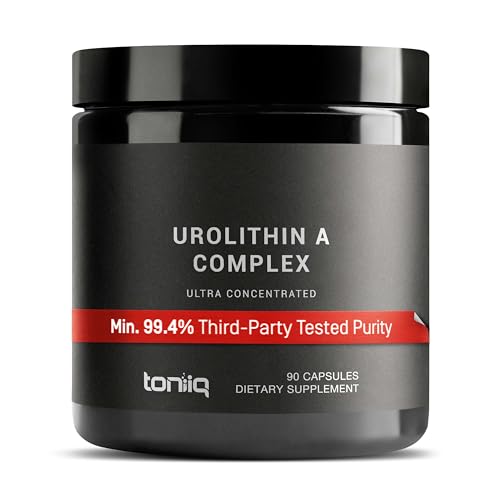
Mitopure, made by Timeline Nutrition, is the most studied proprietary form of urolithin A, but its price point — premium, with monthly costs that vary by brand (see Amazon for current pricing) — puts it out of reach for many people. As interest in urolithin A has grown, a range of generic and third-party urolithin A supplements have appeared at lower price points, and it is reasonable to ask whether they are comparable.
This article breaks down what urolithin A actually does, why the source and form matter, what the clinical research used, and what you should look for if you are comparing options. It does not recommend any specific brand, and it is not a substitute for advice from a qualified healthcare provider.
Key Takeaways
- Almost all human clinical evidence for urolithin A used Timeline’s Mitopure formulation; generic alternatives have not been tested in comparable trials.
- Urolithin A supports mitochondrial health by inducing mitophagy — the selective recycling of damaged mitochondria — which declines with age [1].
- Trials have shown improvements in muscle endurance, strength, and immune markers in older and middle-aged adults [2][3][4].
- When comparing cheaper options, prioritize third-party purity testing and equivalent dosing (500–1,000 mg/day) over price per capsule alone.
- Preclinical findings in osteoarthritis and mood are mechanistically interesting but have not yet been confirmed in human trials [5][6].
What Urolithin A Does in the Body
Urolithin A is a gut-derived compound produced when bacteria in the colon metabolize ellagitannins — polyphenols found in pomegranates, walnuts, and certain berries. The compound itself is not present in meaningful quantities in food; your gut microbiome makes it, and roughly 30–40% of people lack the bacteria to produce it efficiently.
The primary mechanism researchers focus on is mitophagy — the selective recycling of damaged or dysfunctional mitochondria. Mitochondria are the energy-producing organelles inside cells, and their quality declines with age. Urolithin A appears to activate the cellular machinery that clears out worn-down mitochondria and allows healthier ones to take their place. A 2025 review noted that urolithin A has a distinct role in inducing mitophagy compared to other autophagy-related compounds, with implications for how it should be dosed and studied [1].
By supporting mitochondrial turnover, urolithin A is thought to help maintain cellular energy production in tissues with high energy demands, particularly muscle. This is the basis for most of the human clinical research conducted so far.

What the Clinical Trials Actually Used
Nearly all published human clinical trials on urolithin A have used Timeline’s proprietary Mitopure form. A 2022 randomized trial in older adults found that supplementation improved muscle endurance and several biomarkers associated with mitochondrial health [2]. A separate 2022 trial in middle-aged adults reported improvements in muscle strength, exercise performance, and mitochondrial health biomarkers [3]. A 2024 study in male athletes found benefits for muscle endurance and reductions in markers of oxidative stress and inflammation over eight weeks [7].
A 2025 randomized, placebo-controlled trial examined immune function specifically, finding that urolithin A supplementation improved several markers of age-related immune decline [4]. Most of these trials used doses of 500 mg or 1,000 mg per day of the Mitopure formulation, which is standardized for purity and bioavailability.

The important point here is that the evidence base is largely specific to one manufactured form. When comparing alternatives, the gap in direct clinical trial data is a real limitation to acknowledge.
Why the Form and Manufacturing Process May Matter
Urolithin A is a relatively simple small molecule, but bioavailability — how much actually enters your bloodstream — depends on particle size, formulation, and what else is in the capsule or powder. Mitopure is manufactured through a fermentation and purification process designed to produce a consistently pure compound with documented bioavailability.
Generic urolithin A supplements often list the same ingredient at similar doses, but very few have published pharmacokinetic data showing equivalent absorption. Without that data, price comparisons are somewhat difficult to interpret: a cheaper supplement at the same milligram dose may or may not deliver comparable circulating levels of urolithin A.

This does not mean generic options are ineffective — it means the data to make a confident comparison does not yet exist for most of them. Buyers should look for third-party testing certificates, certificates of analysis from manufacturers, and ideally any published or company-disclosed bioavailability testing.
What Conditions and Populations Have Been Studied
The current human research concentrates on older adults and middle-aged adults, with muscle health and mitochondrial function as primary outcomes [2][3]. There is also research in athletes examining performance and recovery markers [7], and a 2025 randomized trial showing improvements in immune function with age [4].
Animal and cell-based studies have explored other potential applications. A 2022 study reported that urolithin A reduced cartilage degeneration and pain markers in an osteoarthritis model [5]. A 2025 study in a rodent model found antidepressant-like effects linked to the AMPK/CREB/BDNF pathway [6]. A 2023 paper in Nature Aging found that inducing mitophagy could reverse certain age-associated declines in hematopoietic and immune cells [8].
These findings are mechanistically interesting but should not be interpreted as confirmed human benefits. Preclinical results frequently do not translate directly, and the human trials available are still relatively short-term and focused on specific populations.
How to Compare Urolithin A Products Practically
If you are evaluating alternatives to Mitopure on price grounds, here is a practical framework. First, check the dose: most trials used 500–1,000 mg per day, so products offering 250 mg per serving at a comparable price are not actually cheaper on a per-dose basis.
Second, look for third-party testing. Reputable supplement manufacturers provide certificates of analysis from independent labs confirming purity, absence of heavy metals, and absence of microbial contamination. This matters especially for urolithin A, where adulteration with cheaper ellagitannin extracts — which your body may or may not convert — is a plausible but understudied risk.

Third, consider whether the manufacturer has done any bioavailability work. Some newer entrants to the market have commissioned pharmacokinetic studies comparing their product to reference standards. That kind of data is more meaningful than ingredient sourcing claims alone. Finally, read the label for excipients: some delivery formats, such as soft gels with lipid carriers, are designed to improve absorption of fat-soluble compounds, though urolithin A has reasonable water solubility on its own.
Honest Perspective on Cost vs. Evidence
The honest framing is this: the clinical evidence base for urolithin A improving muscle endurance [2], physical performance [3], and immune markers [4] is real and published in peer-reviewed journals. That evidence was generated with a specific, well-characterized product.
A cheaper generic supplement may contain the same active compound and may work comparably — but the studies proving it works were not done with that product. If cost is the primary driver, a reasonable middle path is to choose a generic that has third-party purity testing, uses the same dose range studied in trials (500–1,000 mg), and comes from a manufacturer with transparent sourcing. Accept that you are making a plausible extrapolation, not following the exact evidence trail.
For people with serious health concerns, especially older adults with significant muscle loss or those managing chronic conditions, the case for using the best-documented form is stronger. For healthy adults looking to support general mitochondrial health and willing to accept some uncertainty, a verified generic at a lower price point is a defensible choice.

🛒 Where to Buy Urolithin A
- Timeline Mitopure SoftgelsClinically studied
softgels, 500 mg/day — The clinically studied form (Amazentis); used in the human trials. - Pure Encapsulations Renual
caplique capsules, 250 mg Mitopure Urolithin A/serving (with resveratrol + CoQ10) — established clinical-supplement brand, third-party tested. - ProHealth Longevity Urolithin A
capsules, 500 mg — Longevity-focused brand, often higher dose. - Double Wood Urolithin A
capsules, 250-500 mg — Budget-friendly, widely available, COA on request.
As an Amazon Associate we earn from qualifying purchases. Prices and availability vary; verify dose and third-party testing before buying.
A Note on the Evidence
The clinical evidence base for urolithin A is promising but still early, with most human trials being short-term and conducted in specific age groups using one proprietary formulation. This article is for informational purposes only and is not medical advice; people with health conditions, those taking medications, and pregnant or breastfeeding individuals should consult a qualified healthcare provider before supplementing.
Frequently Asked Questions
Is generic urolithin A as effective as Mitopure?
There is no published head-to-head clinical trial comparing a generic urolithin A product to Mitopure in humans. The clinical trials showing improvements in muscle endurance and mitochondrial biomarkers were conducted with Mitopure specifically [2][3]. A generic product containing the same molecule at the same dose may be comparable, but that claim has not been independently verified through human trials for most brands on the market.

What dose of urolithin A was used in the research?
The majority of trials used either 500 mg or 1,000 mg of urolithin A per day. The 2022 JAMA Network Open trial in older adults and the 2022 Cell Reports Medicine trial in middle-aged adults both used these dose ranges and found improvements in muscle and mitochondrial health markers [2][3]. When evaluating alternatives, check the serving size rather than just the per-bottle price.
Can urolithin A help with more than just muscles?
Research has examined several other areas. A 2025 randomized trial found improvements in age-related immune decline with urolithin A supplementation [4]. Animal and cell studies suggest potential roles in joint health [5] and mood-related pathways [6], but these findings have not been confirmed in human clinical trials and should be interpreted cautiously.
Does everyone produce urolithin A naturally from food?
No. Urolithin A is produced by gut bacteria metabolizing ellagitannins from foods like pomegranates and walnuts, but an estimated 30–40% of people lack the microbiome composition needed to produce meaningful amounts. This is one rationale for direct supplementation rather than relying on dietary sources. The clinical trials cited here used direct supplementation rather than dietary interventions.
Is urolithin A safe?
The published clinical trials, including multi-week randomized controlled trials in older adults and athletes, have not reported serious adverse events attributable to urolithin A at doses of 500–1,000 mg/day [2][7]. However, long-term safety data beyond the trial durations studied is limited, and supplements are not regulated with the same rigor as pharmaceuticals. Anyone with existing medical conditions or taking medications should consult a healthcare provider before starting.
What should I look for on a urolithin A supplement label?
Look for the dose in milligrams per serving (500–1,000 mg to match trial doses), a certificate of analysis from a third-party testing lab confirming purity and absence of contaminants, and clear disclosure of the manufacturing process or ingredient source. Some brands also publish bioavailability or pharmacokinetic data; this is a meaningful differentiator if available. Avoid products that make explicit disease or cure claims, as these are regulatory red flags and scientifically unsubstantiated.
References
- Borsky P et al. Distinct roles of urolithin A and spermidine in mitophagy and autophagy: implications for dietary supplementation. Nutrition research reviews (2025). PMID 41404767
- Liu S et al. Effect of Urolithin A Supplementation on Muscle Endurance and Mitochondrial Health in Older Adults: A Randomized Clinical Trial. JAMA network open (2022). PMID 35050355
- Singh A et al. Urolithin A improves muscle strength, exercise performance, and biomarkers of mitochondrial health in a randomized trial in middle-aged adults. Cell reports. Medicine (2022). PMID 35584623
- Denk D et al. Effect of the mitophagy inducer urolithin A on age-related immune decline: a randomized, placebo-controlled trial. Nature aging (2025). PMID 41174221
- D'Amico D et al. Urolithin A improves mitochondrial health, reduces cartilage degeneration, and alleviates pain in osteoarthritis. Aging cell (2022). PMID 35778837
- Di Y et al. Urolithin A Exhibits Antidepressant-like Effects by Modulating the AMPK/CREB/BDNF Pathway. Nutrients (2025). PMID 40732919
- Zhao H et al. Assessment of Urolithin A effects on muscle endurance, strength, inflammation, oxidative stress, and protein metabolism in male athletes with resistance training: an 8-week randomized, double-blind, placebo-controlled study. Journal of the International Society of Sports Nutrition (2024). PMID 39487653
- Girotra M et al. Induction of mitochondrial recycling reverts age-associated decline of the hematopoietic and immune systems. Nature aging (2023). PMID 37653255
These statements have not been evaluated by the Food and Drug Administration. This information is not intended to diagnose, treat, cure, or prevent any disease. Content is for informational purposes only and is not medical advice; consult a qualified healthcare provider before starting any supplement. As an Amazon Associate we earn from qualifying purchases.