Urolithin A (UA) is a gut‑derived metabolite produced when intestinal bacteria transform dietary ellagitannins and ellagic acid, compounds found in foods such as pomegranates, berries, and nuts. Over the past decade, pre‑clinical work suggested that UA can trigger mitophagy – the selective removal of damaged mitochondria – thereby improving cellular energy efficiency. Because skeletal muscle relies heavily on mitochondrial health for strength and endurance, researchers have begun testing whether oral UA supplementation can translate into measurable performance benefits in humans.
This article summarizes the peer‑reviewed human studies that have examined UA’s impact on muscle‑related outcomes. The evidence includes randomized controlled trials in middle‑aged adults, male athletes, and highly trained distance runners, as well as systematic reviews that place these findings in the broader context of aging and muscle decline. Each study below is described in the terms its own authors used, including the endpoints that did not reach significance, and the limitations of the current data are highlighted.
Key Takeaways
- UA activates mitophagy, which can improve mitochondrial quality in skeletal muscle.
- Randomized trials report modest gains in strength, muscular endurance and recovery, but the two most-cited trials each missed their designated primary endpoint, and a trial in elite runners found no improvement in race-pace performance.
- Evidence comes from short‑term supplementation (four weeks to four months) and largely from populations already engaged in regular exercise.
- Current data do not prove that UA prevents sarcopenia or replaces other proven strategies such as resistance training and adequate protein intake.
- Further large‑scale, long‑duration studies are required to define optimal dosing, safety in older or clinical populations, and any sex‑specific responses.
Mechanistic Rationale: Mitophagy and Mitochondrial Renewal
Mitochondria are the power plants of muscle fibers, and their function declines with age and intense training. Damaged mitochondria generate excess reactive oxygen species (ROS) and impair ATP production, contributing to fatigue and sarcopenia – the age‑related loss of muscle mass and strength. Mitophagy is a quality‑control pathway that isolates and degrades dysfunctional mitochondria, allowing biogenesis of fresh organelles. Pre‑clinical work showed that UA activates the PINK1‑PARKIN axis, a central regulator of mitophagy, leading to improved mitochondrial respiration in cultured myotubes and rodent muscle [1].
Human studies have begun to measure biomarkers that reflect this process. Human trials have measured these processes in skeletal muscle biopsies rather than in blood. Urolithin A supplementation has been linked to increased expression of mitophagy- and mitochondrial-metabolism-related proteins in muscle tissue, and proteomic screening in trained runners showed upregulation of mitochondria-associated pathways, though in that study the rise in mitophagy markers was a medium-sized effect that did not reach statistical significance and mitochondrial function itself was unchanged [2][3]. While these biomarkers do not prove causality, they provide a plausible mechanistic link between UA intake and the functional outcomes reported in athletes and middle‑aged participants.

Middle‑Aged Adults: Strength and Exercise Performance
A randomized, placebo‑controlled trial in middle‑aged adults tested urolithin A at two dose levels for four months. Muscle strength improved significantly, by roughly 12%, and the authors described clinically meaningful gains in aerobic endurance (peak oxygen consumption) and in the six‑minute walk test. The trial’s designated primary endpoint, however, was peak power output, and on that measure urolithin A did not separate significantly from placebo. Plasma acylcarnitines and C‑reactive protein were significantly lower with urolithin A, and proteins linked to mitophagy and mitochondrial metabolism increased in skeletal muscle [2].
The inflammatory signal in this trial was a reduction in C‑reactive protein rather than in interleukin‑6 or lipid‑peroxidation markers, neither of which was among the reported outcomes. It is also worth knowing who ran it: the study was sponsored by Amazentis SA, the company that makes the Mitopure form of urolithin A, and most of its authors are company employees or board members. These findings suggest that UA may help preserve muscle performance in a population that is beginning to experience age‑related declines, but the study was limited to a relatively short duration and did not assess long‑term muscle mass changes.

Resistance‑Trained Male Athletes: Endurance, Strength, and Protein Metabolism
An 8‑week randomized, double‑blind, placebo‑controlled study enrolled twenty resistance‑trained male athletes taking either 1 g of urolithin A daily or placebo alongside their training. Against placebo, the urolithin A group improved significantly on maximum voluntary isometric contraction and on repetitions to failure. One‑rep‑max bench press and squat both rose, but neither reached statistical significance, either against placebo or against baseline. The measured gains were therefore in isometric force and muscular endurance rather than in maximal lifting strength [4].

The blood results in that trial were mixed rather than uniformly favourable. C‑reactive protein was significantly lower in the urolithin A group than in placebo, but within the urolithin A group it rose significantly from baseline. Interleukin‑6 changes were not statistically significant. Superoxide dismutase, an antioxidant enzyme, fell significantly relative to placebo. 3‑methylhistidine, a marker of muscle protein breakdown, decreased from baseline but not significantly against placebo. The authors cautioned that the sample size was small and limited to young, healthy males, so extrapolation to other populations requires further research.
Highly Trained Distance Runners: Running Performance and Recovery
A 2025 trial in highly trained male distance runners tested four weeks of daily urolithin A supplementation. Running performance, measured as a 3,000‑m time trial, was not significantly improved in either group. What urolithin A did change were recovery‑related measures: ratings of perceived exertion were significantly lower, and creatine kinase, an indirect marker of post‑exercise muscle damage, was substantially reduced following the time trial compared with placebo [3].
Muscle‑biopsy proteomics in that trial showed urolithin A upregulating mitochondria‑associated pathways and downregulating inflammatory ones. The increase in mitophagy markers was a medium‑sized effect that did not reach statistical significance, and mitochondrial function itself was unchanged. Aerobic capacity rose about 5.4% within the urolithin A group, but the difference between groups was not statistically significant. The authors’ own conclusion was that urolithin A aided recovery without further enhancing performance in athletes already at a high training level. The authors highlighted that the study’s short duration and exclusive focus on male athletes limit the generalizability of the results.

Context Within Aging and Sarcopenia Research
Sarcopenia is driven by a combination of reduced mitochondrial capacity, chronic low‑grade inflammation, and impaired protein synthesis. Reviews of the broader literature on UA note that its mitophagy‑activating properties make it a candidate nutraceutical for attenuating muscle aging [5][6]. A systematic review covering five studies and 250 healthy participants, at doses of 10–1,000 mg/day for 28 days to four months, found a dose‑dependent anti‑inflammatory effect and upregulation of some mitochondrial, autophagy and fatty‑acid‑oxidation genes. It reported increased muscle strength and endurance, but explicitly no effect on maximal mitochondrial ATP production, mitochondrial biogenesis or dynamics, gut microbiota composition, anthropometrics, cardiovascular outcomes, or physical function [7].
Nevertheless, the review emphasized that the studies are short‑term (28 days to four months), modest in sample size, and male‑dominant. No trial to date has demonstrated that UA can prevent sarcopenia or reverse established muscle loss in older adults with frailty. Larger, longer‑term studies that include diverse genders, ages, and health statuses are needed before firm clinical recommendations can be made.
Where to Find Urolithin A
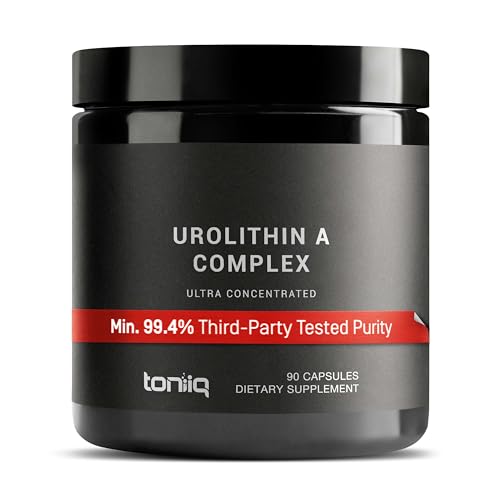
- Double Wood Urolithin A (generic, budget-friendly)
- Mitopure by Timeline (the clinically studied branded form)
As an Amazon Associate we earn from qualifying purchases.
A Note on the Evidence
Current evidence is limited to short‑term studies in healthy or athletic adults; people with medical conditions should discuss UA use with a clinician before starting.

Frequently Asked Questions
What is the typical dose of urolithin A used in human studies?
Muscle‑related trials have used 500–1,000 mg per day for periods ranging from four weeks to four months, and a systematic review of the wider human literature spans 10–1,000 mg/day over 28 days to four months [2][4][3].
Does urolithin A improve muscle mass?
The studies to date report improvements in strength and performance rather than direct increases in muscle cross‑sectional area. No trial has shown a significant gain in lean mass over the short intervention periods used [4][3].
Can urolithin A replace exercise for muscle health?
No. The athlete and runner trials layered urolithin A on top of an existing training programme, while the trials in middle‑aged and older adults did not prescribe training at all; across all of them, exercise remains the primary driver of muscle adaptations. UA appears to augment, not replace, training effects [2][4].
Are there any safety concerns with urolithin A?
Across the published trials, UA was well tolerated with few adverse events. However, long‑term safety data are limited, and individuals with chronic medical conditions should consult a healthcare professional before starting supplementation.
Is urolithin A effective for women or older adults with frailty?
Most published trials have enrolled middle‑aged men or elite male athletes. One systematic review highlighted the paucity of data in women and frail older adults, calling for targeted research in these groups [7].
How quickly might someone notice performance benefits?
Improvements in strength or endurance have been reported after 4–6 weeks of daily supplementation in conjunction with training, but responses vary and are generally modest [2][4].
References
- Ryu D et al. Urolithin A induces mitophagy and prolongs lifespan in C. elegans and increases muscle function in rodents. Nature medicine (2016). PMID 27400265
- Singh A et al. Urolithin A improves muscle strength, exercise performance, and biomarkers of mitochondrial health in a randomized trial in middle-aged adults. Cell reports. Medicine (2022). PMID 35584623
- Whitfield J et al. Evaluating the Impact of Urolithin A Supplementation on Running Performance, Recovery, and Mitochondrial Biomarkers in Highly Trained Male Distance Runners. Sports medicine (Auckland, N.Z.) (2025). PMID 40839339
- Zhao H et al. Assessment of Urolithin A effects on muscle endurance, strength, inflammation, oxidative stress, and protein metabolism in male athletes with resistance training: an 8-week randomized, double-blind, placebo-controlled study. Journal of the International Society of Sports Nutrition (2024). PMID 39487653
- D’Amico D et al. Impact of the Natural Compound Urolithin A on Health, Disease, and Aging. Trends in molecular medicine (2021). PMID 34030963
- Faitg J et al. Mitophagy Activation by Urolithin A to Target Muscle Aging. Calcified tissue international (2024). PMID 37925671
- Kuerec AH et al. Targeting aging with urolithin A in humans: A systematic review. Ageing research reviews (2024). PMID 39002645
These statements have not been evaluated by the Food and Drug Administration. This information is not intended to diagnose, treat, cure, or prevent any disease. Content is for informational purposes only and is not medical advice; consult a qualified healthcare provider before starting any supplement. As an Amazon Associate we earn from qualifying purchases.